The Author – Bart Busschots
Creative Commons
Unless otherwise stated, the content on this site is licensed under Creative Commons Attribution, Noncommercial, No Derivative Works 3.0 License






May
4
Science Podcast Recommendations
Filed Under Science & Astronomy | 1 Comment
I promised a colleague in work that I’d send him on a list of the science podcasts I recommend, but as I was composing the email I realised this might be of value to others, so I’ve compiled my list as a blog post instead. These are all podcasts I listen to religiously, and in most cases, podcasts I have been listening to for many years.
- Astronomy Cast
- The show’s tagline is “not just what we know, but how we know what we know”, and what could be more scientific than that? The show doesn’t just aspire to that tag line, it lives up to it, and that’s the main reason I’ve been a happy subscriber for many years. The episodes are about 30 minutes long on average, and come out about once a week. Details at www.astronomycast.com.
- Big Picture Science
- This show is produced by the SETI institute, but it’s a general science show, not a show focused only on SETI or even astronomy. This show is syndicated across many radio stations in the US, so it’s no surprise that what you get is a professionally scripted, presented, and edited show with amazing guests. The fact that the hosts are friendly and have a good report with each other is the icing on the cake. Details at radio.seti.org.
- Gastropod
- This is not a pure science show, but there’s a lot of science in it, and it’s definitely a show that does its best to separate fact from fiction. The show’s tag-line is “Food with a side of science and history”, and that sums things up pretty well. This is not a show where you go to learn how to cook, or to pick up interesting recipes. Instead, it’s the kind of show where you learn things like how you can turn the same basic ingredient, milk, into so many and such varied cheeses. This is a professionally scripted and produced show, and it’s released in seasons, so you often have to wait a while for new episodes to come out. I’ve always found it to be worth the wait though! Details at gastropod.com.
- The Jodcast
- This is a hard-core astronomy show produced by postgraduate students at the University of Manchester and the Jodrell Bank radio telescope. They do a main monthly show, and most months, you also get a bonus extra show about half way through the month. If you’re into Astronomy I think you’ll love the Jodcast, but if you’re not, this show is probably not for you. Details at www.jodcast.net.
- The Naked Scientists
- A professionally produced weekly podcast covering general science. The show is produced in the UK, and its original incarnation was as a BBC radio show. The show is about an hour long, and always very well researched and paced. One of the things I love about the show is that they put a big focus on interviewing the actual scientists who wrote the papers that are making the scientific news the show covers. Press releases and news reports can’t describe the context and significance of a result nearly as well as the people who actually did the work! Details at www.thenakedscientists.com.
- Naked Astronomy
- This is an astronomy-focused spin-off from The Naked Scientists. Episodes tend to be about half an hour long, and are obviously completely astronomy focused. If you enjoy the style of The Naked Scientists, and you like Astronomy, then you should enjoy Naked Astronomy. Details at www.thenakedscientists.com/podcasts/astronomy.
- Science Vs
- I only discovered this show recently, but it’s so good I listened to every show in the archive within the first week of discovering it. The idea is very simple – each episode the show takes on a controversial topic, and looks at it from a purely scientific perspective. Does immigration drive up crime? Do specific gun controls actually reduce deaths? Does removing guns from a society increase crime rates? Does having an abortion increase a woman’s chances of getting breast cancer? The show doesn’t shy away from any of today’s hot topics, but it’s totally apolitical – it’s about the science of these topics, not the politics, and I find that very refreshing. While the show has no problem tackling the big issues, there are also more light-hearted episodes like one which asks the vitally important question – are wine and chocolate good for us or not? Details at gimletmedia.com/science-vs.
- Star Talk Radio
- This is astrophysicist Neil deGrasse Tyson’s ever-growing network of shows. While there’s often an astronomical focus, these are definitely general science shows, and they tend to be a nice mix of informative and fun. The format always involves a mix of scientists and comedians, which might sound odd, but it really works – it keeps you laughing and learning. The comedians play the role of the everyman perfectly, asking all the “dumb” (no such thing) questions you’re probably shouting at your phone as you listen. Details at www.startalkradio.net.
Dec
13
These are my slides from the talk I gave to Astro 2, the Maynooth University Astronomy and Physics Society on the 13th of December 2016.
Dec
1
The slides for my talk to Astro2, the Astronomy & Physics society of Maynooth University.
The slides refer to demo scripts. These are scripts for the free and open-source planetarium software Stellarium. You can download the scripts here, and you can get instructions on how to install the scripts into Stellarium on their documentation wiki – specifically, you’ll need the section on file locations, and the section on installing scripts.
Oct
23
Last night I gave a talk to Astro2, the Astronomy & Physics society in NUI Maynooth. This is a slightly updated version of a talk I’ve been developing over the past few years. It’s an hour long an aims to explain the jargon you’re likely to come across on Astronomy websites (or magazines if you still do the dead-tree thing), to quickly summarise the kinds of things you can see in the sky, and to look at the kinds of equipment you might want (no, you really don’t need a telescope).
Jun
8
Photographing Satellites
Filed Under Science & Astronomy, Photography | Leave a Comment
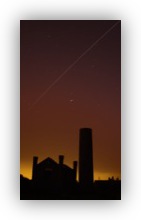 Ireland is actually quite far north, so our summer nights never get fully dark. You watch the sun set, but the glow on the horizon doesn’t go away, it slowly moves from the west through the north to the east where the sun rises again. This takes away a lot of astronomical opportunities, but, when one door closes, another opens. Because the sun never gets far below the horizon during the summer in higher northern latitudes, the part of space where satellites orbit remains in sunlight the whole night long, which means summer is satellite observing time! (The same is true in the southern hemisphere for far southern latitudes during their summer.)
There are lots of ‘ordinary’ satellites which can be seen pass over each night – they look like stars that move slowly but purposefully across the sky – taking a few minutes to cross from one side of the sky to the other. These can be fun to watch, and you can photograph them with a bit of effort, but, the stars of the show are the International Space Station (ISS), which blazes across the sky shining brighter than any star, and the network of Iridium communication satellites which ‘flare’ regularly. Any satellite can ‘flare’, when the sun glints off a solar panel or communication dish, but those flares are not predictable or dependable. Iridium flares are different, because the Iridium Satellites have massive dishes pointing earthwards at all times, and as they pass over-head, the dish will come into alignment with the sun, and what starts off looking like a regular dim satellite will suddenly brighten for a few seconds and then dim again. The flare is effectively a cone that sweeps the earth, if you are in the very middle of the cone, the flare will be spectacularly bright, down to magnitude -8. For context, the magnitude scale is inverse, so the lower the number the brighter the object. The brightest stars are about magnitude 0, the brightest planets about magnitude -4, and the Moon about magnitude -11, so -8 is getting close to the brightness of the Moon!
Dec
22
I recently gave a talk to Astro2, the Astronomy and Physics Society in NUI Maynooth. The talk focused on taking photos of the heavens without breaking the bank. If you set your expectations appropriately you can shoot the sky with literally any camera. You’ve not going turn your iPhone into the Hubble Space Telescope of course, but you can always get something nice, even if it’s “just” including the Moon and planets into your landscape shots.
The core idea is that you need to take as much control away from the camera’s computer as possible, so that you can push the device right up to it’s limits. To do that you need to understand how your camera works, so the talk starts with a primer on the theory of photography.
The talk is very heavily illustrated with example photos, and each example comes with a description of the settings used when shooting it.
I was asked in the talk to upload the slide deck, so I have (sorry it took so long).
Jan
29
Tips for Photographing Stars With Basic Equipment
Filed Under Science & Astronomy, Photography | 9 Comments
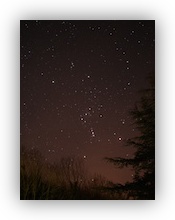 Hard-core astrophotography is very difficult, and requires quite a lot of quite expensive equipment, but, you can do surprisingly much with surprisingly little if you don’t set your expectations unrealistically high. The big problem with the night sky is that it moves. Well, strictly speaking it’s the earth that’s moving rather than the sky, but the point is, stars don’t appear to stand still. Normally when you have a subject that’s dim, you use a tripod and just leave the shutter open for as long as it takes, but since everything astronomical is always on the move, that doesn’t work! The way the pros get around this is with expensive mounts that track the movements of the heavens, opening up the possibility of long exposures. With that problem over-come the pros then run into a whole new set of problems with how noise builds up in sensors over long exposures, so they end up needing some quite advanced techniques and a lot of software and skill as well as the fancy hardware.
I don’t have any of the fancy gear, nor any of the fancy software, nor indeed, the skills needed to get good results out of the equipment I don’t have! But, I can still get a descent shot of a star field, and all I need is three things:
- A camera that will allow manual control of the aperture, shutter speed, ISO and white balance, exposure times of up to 30 seconds, and manual focusing or some form of focus lock
- a tripod
- A remote shutter release (or, as a work-around, a delayed shutter release mode)
I did also mention that you need realistic expectations, basically, what we’re aiming for here is shots of large sections of the sky. Think a nice shot of a constellation. If you have visions of detailed views of spiral galaxies in your head – get them out now – that’s for the pros with their fancy kit!
Dec
17
The Christmas Star & Apollo
Filed Under Science & Astronomy | 2 Comments
It’s become sort of a tradition that each year I give the Christmas lecture for Astro2 (The Astronomy & Physics Society of NUI Maynooth). Each year I give a talk on the Christmas Star and each year I change it up a bit and focus more on different aspects. I really changed the talk up quite a bit this year and got quite a bit deeper in the biblical end of things than I had before. I enjoyed giving the talk this evening, and the audience seemed to enjoy it too which is always nice!
Oct
29
Another Irish Asteroid!
Filed Under Science & Astronomy | 4 Comments
They’re coming thick and fast now! It’s only a few weeks ago that I happily blogged about my friend Dave McDonald becoming only the second person ever to discover an Asteroid from Irish soil. Well, another of the shining lights of Ireland’s amateur astronomical community (and another Dave as it happens) has discovered the third ever astroid from Irish soil! Dave is a very active amateur who’s involved with both Astronomy Ireland and the Irish Federation of Astronomical Societies. Dave, if you’re reading this, congrats!
If you’ve ever wondered just how much of a needle in a hay-stack an asteroid is check out the observations of the asteroid on Dave’s website, the animation in particular rams home the point!
Oct
10
I’m absolutely delighted to be able to say that a local amateur Astronomer and friend of mine, Dave McDonald, has discovered an Asteroid. This is not just a big deal for him, it’s a big deal for Ireland. This is only the second ever asteroid discovered here, and the first since 18 something (about 160 years ago). Dave is one of the leading lights in the Irish Federation of Astronomical Societies and was rightly voted Astronomer of the Year last year by the IFAS members. Guess he’s a shoe-in for this year too 😉
Dave is the perfect example of an amateur astronomer doing real science. His setup is in many ways quite modest, but he has it tuned to perfection and has really nailed it’s operation. Dave is getting more out of his gear than anyone else I know. The asteroid he discovered was an insanely dim magnitude 19. This is also not Dave’s first success, last year he made the official confirmation observation of a supernova. I don’t know of any other sciences where amateurs can contribute so much real scientific work in this day and age.
You can find out more about Dave at his website, www.astroshack.net.
If you’re reading this Dave, I offer my heart-felt congratulations, I knew all your hard work and dedication would eventually pay off and you’d strike gold one of these days!